Taborian Hall Museum
The story of Taborian Hall is more than a century old. The museum on the first floor of the building tells that story through artifacts, photographs, and a timeline that spans from the building's construction in 1916 to the present day.
Admission is free. Walk in anytime Monday through Friday, 9 AM to 5 PM. Beginning in September 2026, the museum will also be accessible during Dreamland Lounge hours - Friday, Saturday, and Sunday evenings from 5 PM to 10 PM.
For the full experience, book a guided tour with Friends of Dreamland Executive Director Matthew McCoy, who knows this building and its history better than anyone.
The Timeline
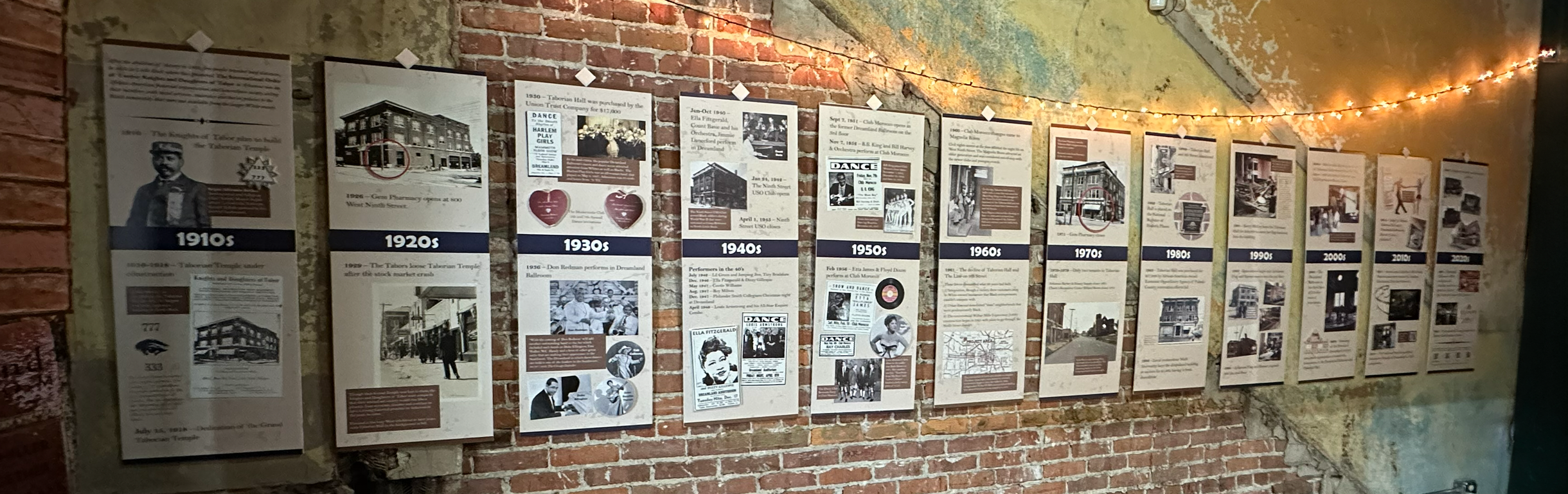
The north wall of the museum features a decade-by-decade timeline of Taborian Hall and the Dreamland Ballroom, from the 1910s through the 2020s. Photographs, newspaper clippings, and historic documents trace the building's journey from fraternal headquarters to USO club to jazz venue to its current restoration.
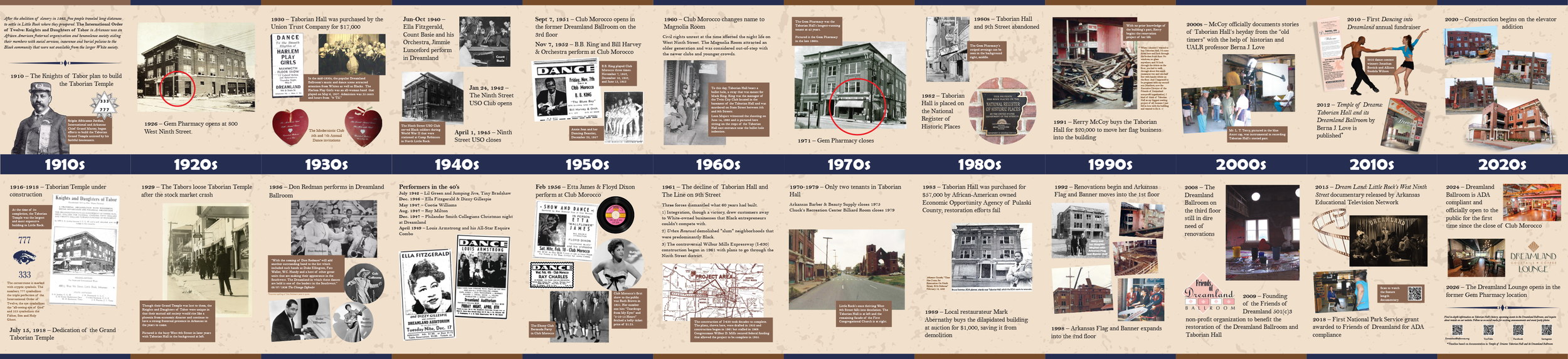
Click to view a larger image.
The Artifacts
The Cornerstone and the Bricks Outdoors
Taborian Hall was completed on July 14, 1918 at a cost of approximately $65,000 - the most expensive building constructed in Little Rock that year. It was built entirely by and for the Black community of Arkansas. The contractor was Simeon "Sim" Johnson, an African American builder from Little Rock. The distinctive blood-red bricks were fabricated by inmates at "The Walls," the State Penitentiary on Roosevelt Road. Every brick in this building carries that history.
Ceremonial Sword of the Knights and Daughters of Tabor
The fraternal organization that built Taborian Hall was as much a civic institution as a social one. The Knights and Daughters of Tabor provided mutual aid, life insurance, and community support to Black Arkansans at a time when those resources were otherwise unavailable. This ceremonial sword is a rare surviving artifact of their rituals and traditions.
Knights of Tabor Organizational Manual
A printed copy of the organizational manual that governed the Knights and Daughters of Tabor - their rules, rituals, and hierarchy. The elaborate officer titles within the organization reflect the pride and formality with which members approached their civic mission.
USO Architectural Drawings, 1940s
When World War II brought thousands of Black servicemen to Little Rock, Taborian Hall was converted into the Ninth Street United States Officers Club. These original architectural drawings document that transformation - the moment the building shifted from fraternal headquarters to wartime gathering place.
Excavation Bottles
During the excavation for the elevator addition in 2019, workers uncovered these glass bottles buried beneath the building. Physical artifacts from the layers of history literally beneath our feet.
The Coca-Cola Sign
This sign hung on the outside of Taborian Hall through the 1950s and until it was restored in 1990. Two red round signs above the Gem Pharmacy windows bade visitors to come in and have a refreshing drink. A small piece of mid-century Little Rock hiding in plain sight.
Gem Pharmacy Sign (Coming Soon)
Gem Pharmacy operated out of the southeast corner of Taborian Hall from the late 1920s through the 1970s. Dutifully hanging until restoration in 1990, its sign will soon join the museum collection - a nod to the pharmacy that served The Line for nearly four decades. Today the Dreamland Lounge occupies that same corner.
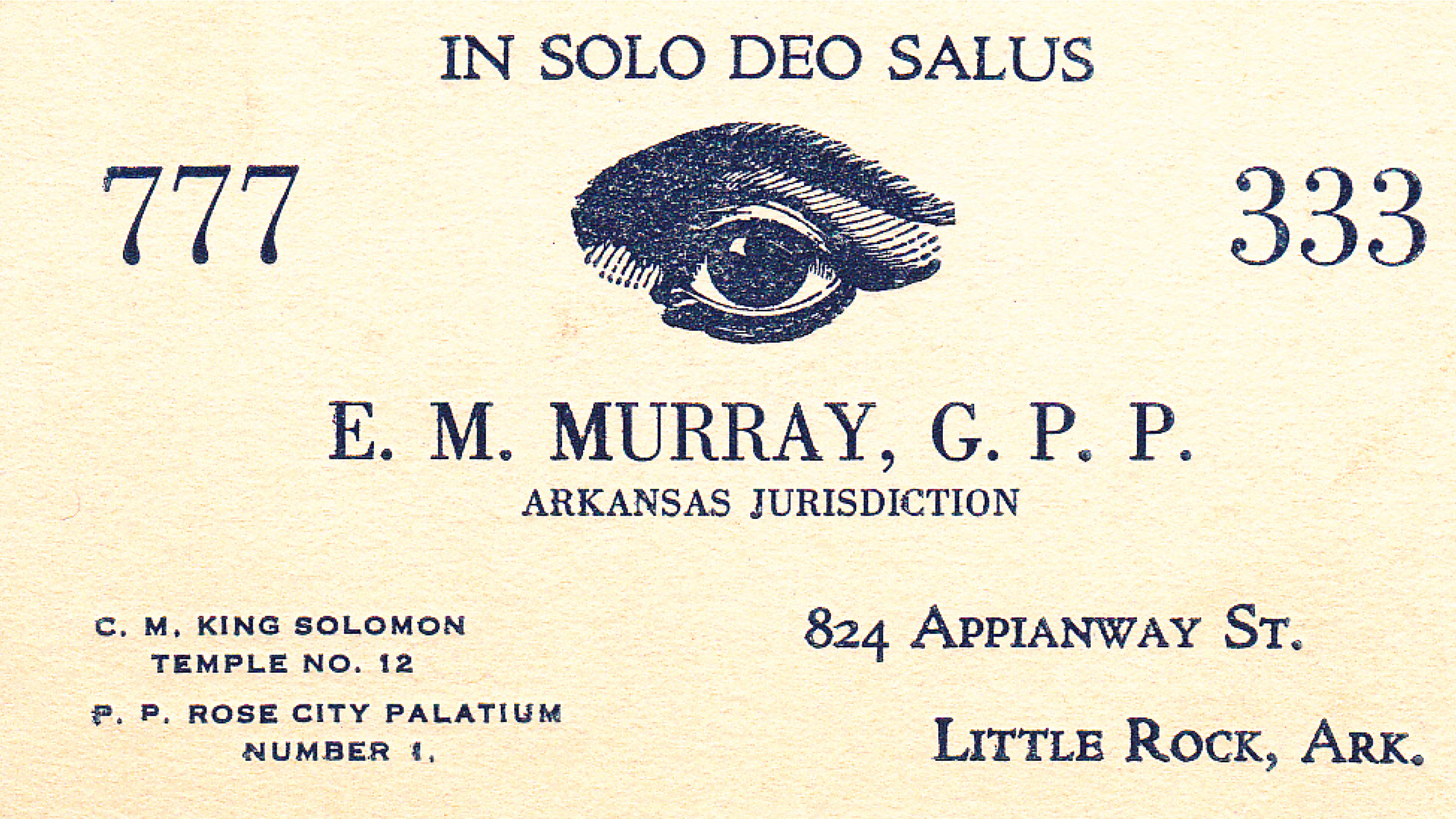
Business Card of E.M. Murray, G.P.P., Arkansas Jurisdiction
One of the earliest surviving artifacts connected to Taborian Hall's commercial life. The card bears the symbolism of the Knights and Daughters of Tabor, suggesting Murray held an officer position within the Arkansas jurisdiction of the organization. G.P.P. likely denotes a grand officer title within the Tabor hierarchy.
Portrait of Scipio Africanus Jordan
Scipio Africanus Jordan served as International and Arkansas Chief Grand Master of the Knights and Daughters of Tabor. It was his vision and leadership in the 1910s that set in motion the construction of Taborian Temple - the building you are standing in today.
Duke Ellington
A photograph of one of the most celebrated artists to perform on the Dreamland Ballroom stage. Ellington appeared at Dreamland in 1936 alongside Fats Waller and W.C. Handy.
West 9th Street in the 1940s
A photograph of The Line at its peak - when the street was alive with commerce, music, and community. This is what was here before. This is what we are working to honor.

The Building Is the Artifact
Everything in this museum points back to the walls around you. The proscenium plaster crest in the museum hallway was created by hand. The tin ceiling tiles were replicated from original molds. The elevator addition that takes you to the ballroom was funded by the National Park Service's African American Civil Rights Preservation Program.
This is not a building that was saved and frozen. It is a building that is still becoming what it was always meant to be.
Book a Guided Tour
Matthew McCoy, Executive Director of Friends of Dreamland, leads guided tours of Taborian Hall and the Dreamland Ballroom. Tours cover the full history of the building, the West 9th Street district, and the ongoing restoration. Tours last approximately 45-60 minutes.