by Kyle Brazzel
Arkansas Democrat-Gazette
Dec. 30, 2008
Eclectic Band Takes Under Its Wing A Battered Dance Hall With A Glorious Past
Onzell Wright has a keen nostalgia for Little Rock’s Ninth Street, similar to the feeling some people have about Main Street. In both cases of these intersecting corridors, this is mostly nostalgia for one’s youth and for crowds. But the way Wright tells it, his particular strain sounds like an anomalous wistfulness for one-stop shopping.
Ninth Street, by Wright’s careful enumerations, was once a place where you could get your clothes dry-cleaned and study to be a beautician. You could buy a life insurance policy and a chili dog. He makes the type of businessmen who tack their business cards to laundromat bulletin boards sound like old friends.

In a way, it’s loneliness talking. Wright graduated from high school in 1962 and proceeded almost directly to The Line, in those days the nickname for Ninth Street. “That’s when I was really partying,” he says with the hint of a grin. In those days Ninth Street was the center of commercial and cultural life for Little Rock’s black population, and it was also the place to party. But when Wright returned in the 1970s to open wright’s Shine parlor near Ninth and Arch streets, the vitality was fading. Now its history is a museum exhibit, literally, at the Mosaic Templars Cultural Center, which opened in the fall.
As someone who came to Ninth street first to play and later to work, Wright is an exception. But it’s not only neighbors whose absence he feels “There was a lot of neon lights down here, just about as many as there was on Main Street,” Wright recalls. And there was sound, plenty of it, spilling out onto the sidewalks. wright has always situated himself near music, whether at work or not: When he operated a shoeshine stand in Little Rock’s erstwhile Sheraton Inn, he could hear Gennifer Flowers’ night club act from inside the Pebbles Lounge.
Up and down the Ninth street of his youth,” you could hear the blues, you could hear rock’n’roll, you could hear band music,” Wright says. Bass guitar hung in the air, but so, he remembers, did the bright tones of saxophone and clarinet. These days, it can be difficult to hear Wright speak over the whir of a shoe polisher and the somber chords that announce that The People’s Court, broadcast over a television set so blurry the picture is practically scrambled, is in session.
But one the right night on the Ninth Street, music- even the brassy sounds from Wright’s most distant memories- still carries over to a marginally more bustling Broadway. One can hear guitar and drums, tambourine and even trumpet and euphonium spill from the former Doc’s Pool Hall on the ground floor of the Arkansas Flag and Banner building when a band is playing, the beer keg is flowing and the door to the garage bay is thrown open.
These jam-filled parties, of which there have been a small handful, would earn Wright’s approval for more reasons than their role in bringing a groove back to Ninth Street nights. They are also pushing toward a resurrection that would provide an even more direct link between Wright’s boy hood in the area and his advanced adulthood.
The music, under a street-fair-style string of lights and within a circle of ecstatic dancers, has largely been the instrumental sound of the newish Little Rock band Eclipse Glasses, and outfit whose official motif, according to its promotional materials, is a stew of “funk, soul, electro Afrobeat, reggae and weirdo disco.” The quintet is playing in the former Doc’s tucked underneath the red-brick structure constructed in 1846 as the temple of the Pulaski County chapter of the Knights and Daughters of Tabor because they can’t yet play on the top floor.
Jazz Age Gem

But the band hope that the proceeds from the concerts will help boost Kerry Mccoy, owner of the Flag and Banner building, closer to her goal of restoring the former Dreamland Ballroom. The ballroom, later known less memorably as the Morocco Club, occupies the uppermost story of the building McCoy took over in 1991.
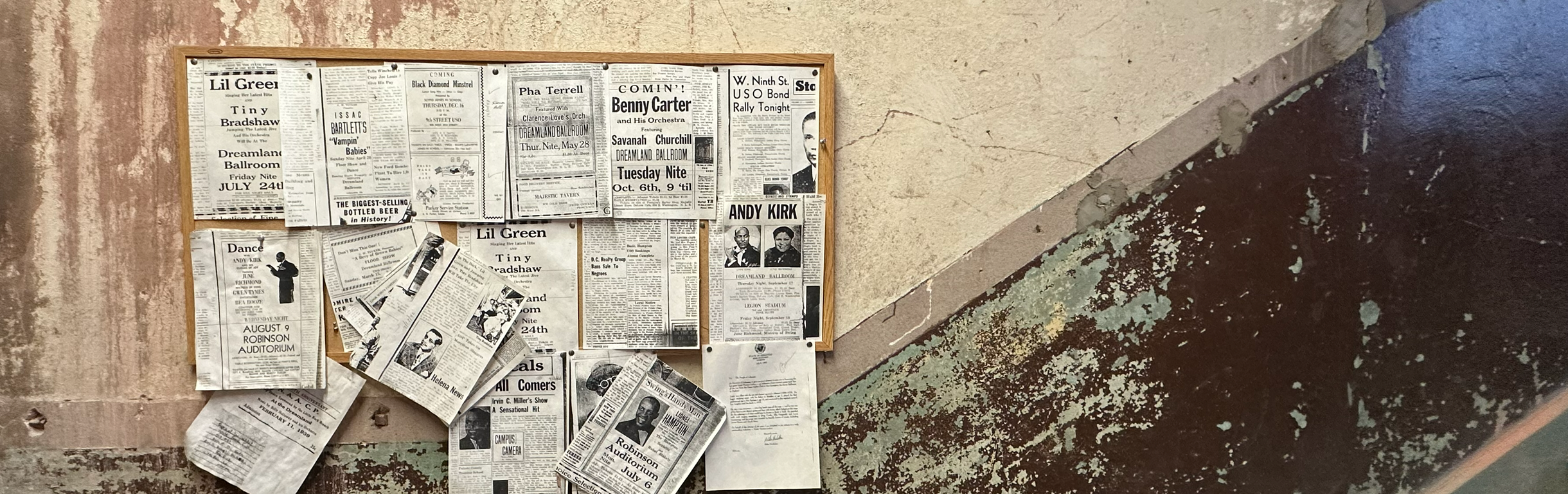
Obscured by peeling plaster and ribs of exposed beams it retains only a glimmer of its sequins-and-spats shine from days when it hosted Cab Calloway, Ella Fitzgerald, Count Basie, Duke Ellington and the proms of Dunbar High School and Arkansas Baptist and Philander Smith colleges.
“Being an admirer of all those people who played there before, I would love to be able to play there too,” says Lorenza Harrington, who supplies the horn sounds for Eclipse Glasses and methodically sets up photo collages showing Dreamland’s promise b3fore each fund raising show. “It’s a beautiful venue. The old ’30s and ’40s architecture is all around you.”
Indeed, it’s still there, although evidence is strong of the weather beating it took before McCoy’s extensive refurbishing. A scrapbook of the buildings’ evolution contains photos in which the diamond-patterned panels edging the balconies sit underneath such gaping holes in the roof that what were then downtown Little Rocks’ First Commercial Bank and TCBY towers loom int he open air. A patina the color of dried mustard has settled on the rosettes ornamenting the band-stand, lending the room a garish quality of glory gone shabby, like a once-grand dame whose hair rinse is beginning to yellow and whose lipstick applications stray off the mark.
In fact, knowing what to keep and what damaged flourishes to cut have proven so tricky that MCCoy has already fired two architects whose conceptions woud have, she felt, takent the Dreamland too far from its original design.
“The sstinking historical people that do the tax credits- they told me I had to take all the plaster out fo the way and spray it with clear shellac,” reports McCoy, who originally bought the building for $20,000 from restaurateur Mark Abernathy, who had bought the property at auction on the Pulaski County Courthouse steps.
“I said, ‘You’re missing the whole deal!’ I’m not going to loose my peachy-pink color just so I can get those tax credits.”
In some ways – coinciding, as it does, with a mini-Ninth Street revival as well as the movement to rebrand South Main Street as SOMA – the Dreamland may be the right project at the wrong time. McCoy was prepared to go before loan officers with her revised business plan for Dreamland’s eventual profit ability as a for-rent event center and concert venue the week of the initial bank-industry financial crisis.
McCoy says she is grateful for the money that goes into Dreamland restoration coffers after Eclipse Glasses organizes a charity concert. “They get me a couple thousand dollars,” she says. “But I need a million-two.” Members of Eclipse Glasses understand that they aren’t going to move the mountain of big-ticket financing with proceeds from the occasional late-night get-down. “just having music there at all brings about an awareness of that place,” Harrington says. (The next fundraising concert is not yet on the calendar, but progress on the restoration effort can be followed at the
ballroom’s Web Site, www.dreamlandballroom.com.)
Trumpeting the Cause
And the devotion to the Dreamland held by Eclipse Glasses, as well as other bands of their ilk, casts them as much Generation O as the successors to the bluesmen and rock’n’rolers who lugged their instruments cases through stage doors in Ninth Street’s heyday. Generation O is the nickname that has been applied to people college age on through their early 30s who helped president-elect Barack Obama reach unprecedented levels of campaign fundraising, one relatively minute, Internet deposited contribution at a time. The tag also signifies a new order of social consciousness, and members of Eclipse Glasses – Harrington, Zach Reeves, Kyle Carpenter, Andrew Morgan and Collin Miles – in addition to playing in other bands also volunteer for causes like the Arkansas Sustainability Network and the No New Coal Environmental movement.

Harrington, 26, learned to play on a trumpet given to him by his grandfather when his parents couldn’t afford the drum set he requested as a teenager. A leader of kung-fu-centered after-school tutorials for the Little Rock School District, Harrington is cautious about appearing opportunistic in his Dreamland Boosterism. “I don’t want it to seem like I’m just playing there so whenever it does get remodeled I’ll have my food in the door,” he says. “Before it’s established as a legitimate music venue, people should be aware of its history and not just use it as a place to make money, or boost their own popularity.”
McCoy, for her part, understands the ballroom’s appeal to emerging young musicians. “It’s part of the music heritage of Arkansas – that same bond that ties musicians together generation after generation,” says McCoy, who adds that she bought the property primarily because of the ballroom. (At one time, her goal was to have Dreamland restored by 2000.) “I want to move forward while they’ve still got time on their hands and don’t have families yet,” she says of the current youthful gravitation toward the Dreamland. “But even if they get off of it, there’ll be somebody else that falls in love with it. It’s just that kind of place – as long as I don’t mess it up. I don’t want to sell ownership of it,” she continues” but it may have to someday be Coca-Cola’s Dreamland Ballroom. But I’d like to see it before I’m 80!”
But even if she doesn’t, as Onzell Wright might tell her, it’s never too late to recapture reveries gone by. Wright’s wife maintains a collection of 45s that preserve the type of tunes that once provided the Ninth Street soundtrack. “I’m in church now,” wright says. “I’m a deacon. But every now and then, we spin some old records at the house and dance.”